

If you turn back the clock 10 years ago, everyone saw exactly the same search results. Today, this is no longer the case, no one sees the same search results, not on Google, not on Bing. Search results today are personalised, and to some degree based on your past search behaviour.
So what exactly do we mean by personalised search results?
Search engines like to make each searcher’s results as relevant as possible, which means they have to get to know the searcher, the query, and the results better.
To do this search engines use a combination of techniques to personalize the results based on past searches you’ve run, sites you’ve visited, and files you’ve downloaded, so the search engine can adjust new search results to include items that will interest you.
So what does this mean and why should you care?
In SEO when we talk about Personalization and Locality we are referring to how search engines personalize your organic search results to best suit your query and how your I.P address, gives search engines your country, city or location, your personal history of search results as well as social connections.
Why should you care about this as a business? Simple. With consumers increasingly searching via their mobiles phones, local SEO becomes increasingly important! When searching on your mobile phone search engines will prioritise results with a local address or listing on Google Maps.
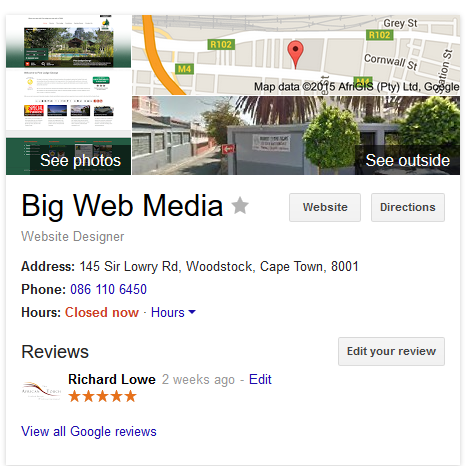 What that means is your business location has to appear on the Google Search Engine Results Page (on the right-hand side), in order to be found.
Let’s look at a real life example here:
I did a search and typed in ‘Barbecue’ as a keyword. As we know Americans use the word barbeque when referring to braai. Interestingly, Google provided me with places where I could my nearest barbecue, only thing is: it wasn’t in America! Instead the locations were a few kilometres away and it was personalized according to my location (Cape Town).
These factors will help you understand better how search engines rank personalized results.
• Country – The first thing a search engine will look at is where the search is coming from. For any website to take advantage of personalization it will have to be relevant to a certain country, if not then your chances of personalizing your website are pretty much non-existent.
• City / Locality – As seen on our example earlier, localization is important in getting your customers to your business as they may be closer than you think!
• Personal History of search results – This is another method search engines help your customers to get the search results they need. The search engine will provide a ‘profile’ for the user and gather their interest according to the history of their search.
• Personal Social connections – People who have’ liked’ or commented on your social platform give away your location and that is how search engines personalize your search results.
• Personal mail vs. Work mail – A search engine will provide you with different results when making a search using your work email instead of your personal one.
Now that you can see how important it is as a business owner to always think of localization and personalization when it comes to your customer’s organic search results, let’s take a look at how you get there.
In SEO when we talk about indexation and accessibility we refer to how search engines interpret the content (photos, videos, words) on your website and whether it enables crawling.
 For crawlers to be able to go index your website its best to use HTML and display it on your site in the form of text, videos, images or any other elements you’d like displayed on your site. HTML coding is not only user-friendly to search engines but to your consumers as well. So the rule is here, whatever is at the back-end must work for the front.
* Crawling refers to a software used by Google to collect websites have relevant content through the search engine.
For you to get an idea of how indexation works, here are a few important factors Google looks at when going through your website.
• The search engine should be able to detect all your links.
• It’s very important to make sure that all your links do work properly.
• Try to keep wording on your images to a minimum.
• Broken internal links should be avoided.
• Original, fresh content is loved by search engines.
• Remove all ‘hidden text’.
• Avoid having page that read: ‘Error on Page’.
• Do not block your site from Search bots.
• Make sure you htaccess file is properly configured.
• A sitemap is needed on your site (sitemap.xml) and should be submitted to Google (Google Search Console).
That basically covers most of what Google Bots would look for when going through your website. Now let’s look at how accessibly to your website can help search engines give you a good ranking.
It’s very frustrating trying to view a website and having to wait for it to load. We’re sure you can relate somehow! And not only that, you probably left the website without even seeing a thing on it. Surely, as a business owner you do not want the same to happen to you.
Here are some tips on ensuring search engines and your customers can easily gain access to your website:
• Try to reduce your image size. Images can easily slow down your website.
• JavaScript resources just like images can reduce internet speed. Reduce their size too.
• Always have your CSS code in your webpage’s heading.
• Look at your caching time it can slow down your connection.
• Compress files on Google Developer.
Most of this will probably sound like greek to you, but it is important for you as a business owner to make sure that your website adheres to these standards. Ask your website designer about these points, it is important that you know.
